
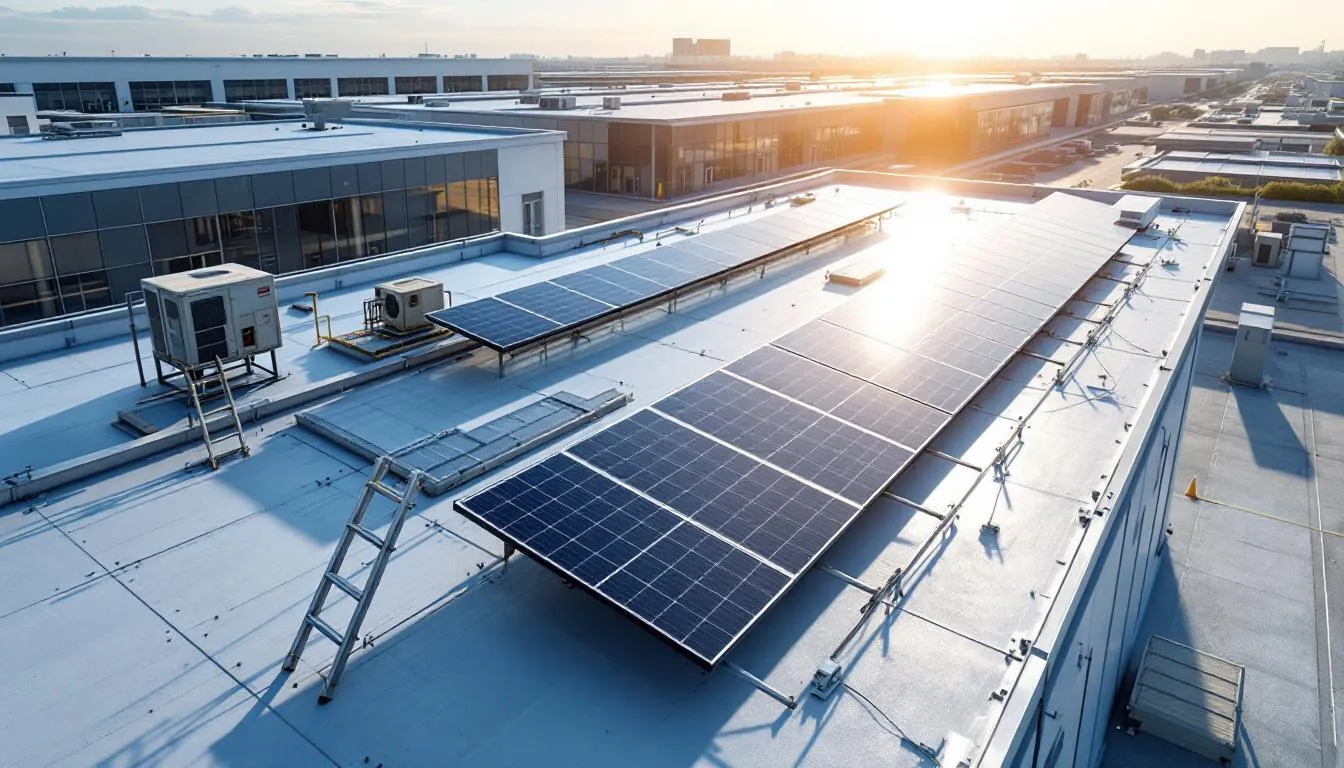
Industrial Flex Space Roofing in McAllen, TX
One Low-Slope Roof, Many Tenants, Years of Modifications
Flex space is the most variable building type in the McAllen commercial inventory. A single multi-tenant flex building off Ware Road, in the Sharyland Business Park, or along the Las Milpas industrial blocks might hold a light assembly shop, a distribution operation feeding the Pharr-Reynosa bridge traffic, a service contractor's yard, and a small office user — sometimes all at once, sometimes a different mix every lease cycle. The roof has to perform across all of it: changing occupancies, tenant-improvement work, and the full range of rooftop loads that come with industrial flex use. That demands a different approach than a single-user warehouse with one roof loading plan that never changes.
The Roof Accumulates Penetrations Nobody Documented
The defining flex roofing problem is penetration sprawl. Every tenant improvement tends to add a rooftop HVAC unit, cut the membrane for new electrical or refrigerant runs, or set equipment that was never in the original loading plan — and most of it never makes it into the property records. So we start every flex scope with a penetration inventory survey: we photograph and map every penetration, compare it against the original drawings where they exist, and flag the non-standard or poorly sealed ones for remediation before any new membrane goes down. That survey is what keeps a warranty dispute from showing up a year after the project closes.
Flex buildings here span everything from 1970s tilt-wall with aging built-up roofing to modern pre-engineered metal buildings with standing-seam panels. The reroof specification follows the deck, the existing assembly condition, and how much disruption the current tenants can absorb. For tilt-wall and concrete flex, a 60-mil TPO mechanically attached over new polyiso is the standard, cost-effective answer. For buildings with heavy rooftop equipment or constant service-contractor foot traffic across multiple tenants, an 80-mil TPO or a 60-mil fully adhered PVC is worth the added cost for its puncture and traffic resistance. Pre-engineered metal buildings often get a standing-seam recover or a coated-metal system that extends service life without a full teardown.
Vacancy and Turnover Are the Hidden Risk
The riskiest moment for a flex roof is a tenant move-out. When a tenant pulls its rooftop units, the curb openings usually get a temporary cover that fails within a rain event or two, and a vacant bay collects debris in the drains faster than an occupied one does. For a building in lease transition, our inspection always confirms curb-cap status, verifies that former-tenant penetrations are properly sealed and not just patched, and checks that the drains are clear. Catching an open curb before the next storm is far cheaper than chasing the leak and the interior damage afterward.
Coordinating Across Multiple Leases
Multi-tenant work starts with a bay-by-bay occupancy map and a lease-contact list from property management. We identify which bays have active rooftop equipment, which sit vacant, and which tenants are sensitive to noise or HVAC downtime during the project. Sequencing and daily dry-in get coordinated through the property manager — tenants receive advance notice but communicate through management, not directly with the crew — so the project moves without turning into a dozen separate conversations on the roof.
Reporting Built for Owners and Portfolios
We price flex roofing per roof square (100 SF) off the membrane specification, the existing assembly condition, penetration density, and the bay configuration, with a fixed-price proposal after a roof walk and a core sample where one is warranted. Investors holding several flex properties get standardized condition reports they can drop straight into capital planning across the portfolio, so a roof on Ware Road and one in Sharyland read the same way on the spreadsheet.
Wind Uplift and the Heat Load on a Low-Slope Flex Roof
Flex buildings tend to be wide, low, and exposed, which makes wind uplift a real design factor here rather than an afterthought. The gusty storms that move through the Rio Grande Valley in the warmer months push the highest pressures at the perimeter and corners, and an older mechanically attached membrane with a tired fastener field is exactly where we see those storms find a starting edge to peel. When we reroof a flex building we enhance the fastening density at the perimeter and corner zones to match the uplift the building's height and exposure actually call for, and we make sure the edge metal is fastened and cleated to hold. The flat South Texas sun is the other constant load: a dark or weathered membrane runs hot all summer and ages faster for it, so the white reflective single-ply we typically specify both meets the cool-roof energy expectation and takes heat off the tenants' rooftop HVAC units, which matters when several different tenants are each running their own equipment off the same roof.
Industrial Flex Space Roofing Questions
We photograph and map every roof penetration, compare it to the original drawings where available, and identify any non-standard or poorly sealed penetrations for remediation before new membrane goes down. That keeps warranty disputes from surfacing after the project closes.
For tilt-wall and concrete flex, 60-mil TPO mechanically attached over tapered polyiso is the common, cost-effective choice. For buildings with heavy rooftop equipment or high service-contractor traffic, 80-mil TPO or 60-mil fully adhered PVC is worth the added puncture and traffic resistance.
We start with a bay-by-bay occupancy map and lease-contact list from property management, identify active and vacant bays and any noise or downtime sensitivities, and coordinate sequencing and dry-in through the property manager. Tenants get advance notice but communicate through management, not directly with the crew.
Per roof square (100 SF), based on membrane specification, existing assembly condition, penetration density, and bay configuration, with a fixed-price proposal after a roof walk and a core sample where needed. Portfolio owners get standardized condition reports for capital planning across properties.
Yes. Pre-engineered metal buildings with standing-seam or R-panel roofs are evaluated for a recover system — silicone-coated metal or retrofit standing seam — against full replacement, based on panel condition, purlin spacing, and load capacity. We specify and install both approaches.
What we document
For Industrial Flex Space Roofing, we record field photos, roof observations, moisture concerns, access assumptions, excluded conditions, and the owner decision that moves the work forward.
Next step
Call 956-302-5444 when Industrial Flex Space Roofing needs a roof walk, repair path, budget opinion, or written scope for a McAllen commercial property.