
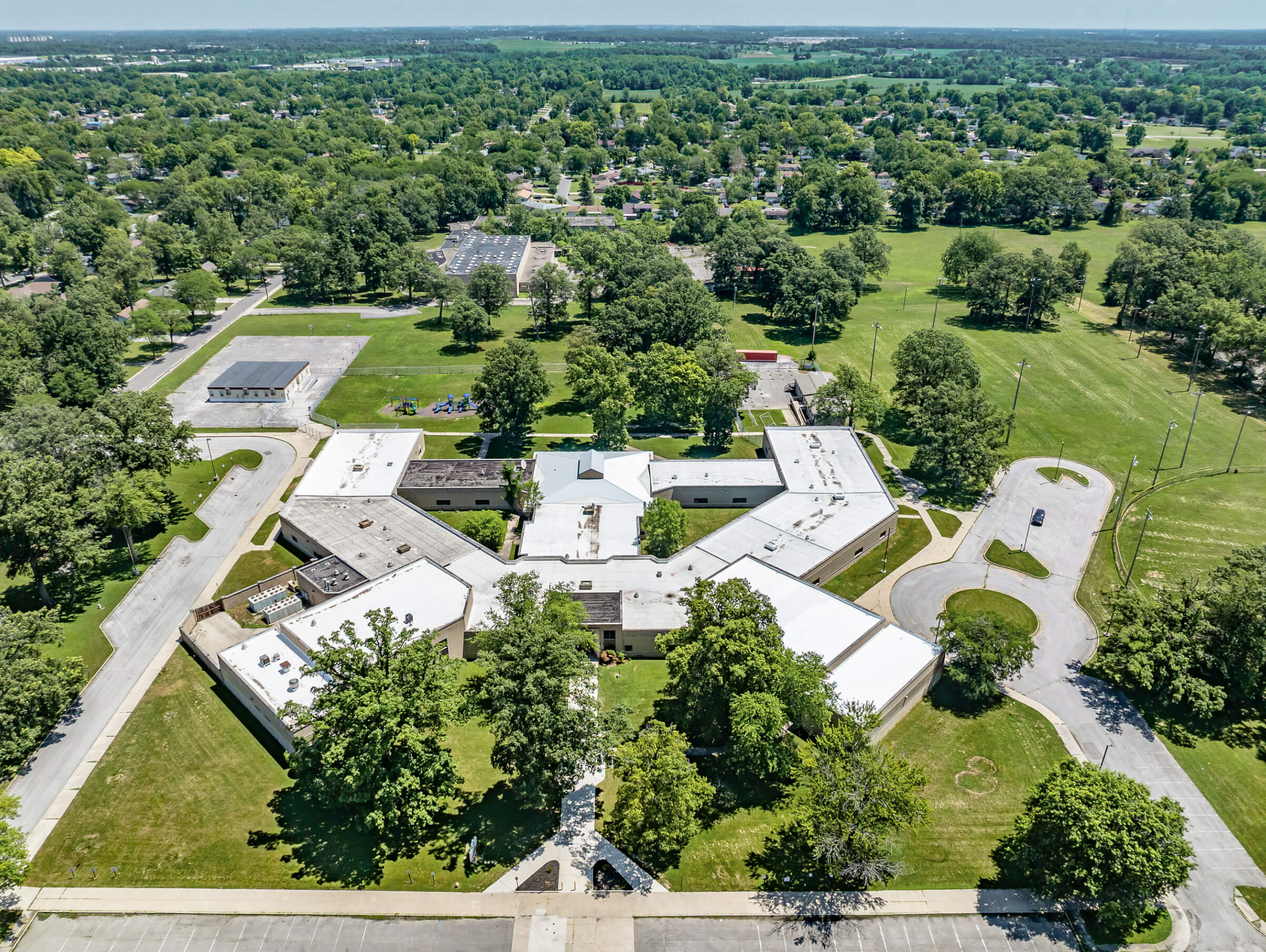
K-12 School Roofing in McAllen, TX
The K-12 School Roofing decision for this project type page starts with the actual building we are standing on, not a canned roof recommendation. For this project type scope on K-12 School Roofing, we look at student schedules, summer phasing, gym roofs, and public-owner documentation, then tie the roof condition to McAllen access, tenant operations, storm exposure, and closeout documentation. For K-12 School Roofing as a McAllen project type page, this local planning point matters: McAllen's checklist references 2018 IBC, 2018 fire, plumbing, mechanical, and fuel gas codes, the 2017 NEC, and 2015 IECC energy compliance, so roof scopes cannot ignore energy, drainage, or fire-rated assembly details.
We treat K-12 School Roofing as a project type roof-file problem before it becomes a material problem. For K-12 School Roofing as project type work, we photograph the membrane, curbs, edge metal, drains, scuppers, traffic paths, rooftop units, deck concerns, and interior leak evidence before we ask an owner to approve work. For K-12 School Roofing as a McAllen project type page, this local planning point matters: The McAllen Chamber notes healthcare assets including Doctors Hospital at Renaissance, Rio Grande Regional Hospital, South Texas Health System, UnitedHealth Group, UTRGV School of Medicine, and DHR Research Institute.
The cost conversation for K-12 School Roofing in this project type scope changes quickly when we find wet insulation, poor slope, loose coping, failed seams, corroded fasteners, or equipment curbs that were never flashed correctly. For this project type file on K-12 School Roofing, we separate repairable conditions from replacement conditions so the building owner can see what is urgent, what can be phased, and what belongs in a capital plan. For K-12 School Roofing as a McAllen project type page, this local planning point matters: Ware Road, Nolana Avenue, Trenton Road, 10th Street, Business 83, Expressway 83, Bicentennial Boulevard, and the Anzalduas-Hidalgo-Pharr border corridors all create different staging and tenant-access constraints.
For occupied buildings, K-12 School Roofing in this project type scope has to respect the people underneath the roof. On K-12 School Roofing project type work, we plan material staging, crane or lift access, odor control, debris handling, noise, tenant notices, loading dock conflicts, and daily dry-in so a roof opening does not become a building interruption. For K-12 School Roofing as a McAllen project type page, this local planning point matters: McAllen Economic Development Corporation describes an international metro population of about 2.4 million, with advanced manufacturing, retail, medical, tourism, and cross-border commerce shaping roof demand.
McAllen heat and tropical moisture make timing important for K-12 School Roofing in this project type scope. For K-12 School Roofing project type planning, we watch surface temperature, afternoon thunderstorms, wind, dew point, and overnight dry-in conditions because the wrong installation window can shorten the life of a repair or coating. For K-12 School Roofing as a McAllen project type page, this local planning point matters: McAllen International Airport identifies an Air Cargo Building at with providers including Ace Forwarding, American Airlines Cargo, Davila's Delivery Valley, and UPS.
When K-12 School Roofing involves an insurance file for this project type scope, we stay in the contractor lane. On K-12 School Roofing insurance documentation for project type work, we document roof conditions, explain storm-related observations, prepare repair or replacement scope notes, meet the adjuster when requested, and avoid promises about coverage or claim outcomes. K-12 School Roofing work needs a project type record that keeps field notes, roof photos, and closeout details tied to one roof decision instead of a generic service label.
The details that decide K-12 School Roofing for this project type page are usually small before they become expensive. During K-12 School Roofing project type roof walks, a split pipe boot, a back-pitched scupper, a lifted lap, a cracked pitch pocket, a clogged drain, or a short counterflashing can send water far from the actual entry point. We trace the k-12 school roofing roof before we write the project type scope.
We also look at roof traffic for K-12 School Roofing in this project type scope. For K-12 School Roofing project type work, HVAC service paths, telecom work, grease exhaust, refrigeration lines, security equipment, solar racking, and maintenance access all change how seams, walkway pads, coatings, and flashings should be protected. That K-12 School Roofing project type roof traffic review is part of our McAllen field notes.
The written scope for K-12 School Roofing should make project type exclusions visible before a purchase order is signed. On project type assignments for K-12 School Roofing, we call out access assumptions, deck unknowns, moisture testing limits, disposal expectations, business-hour restrictions, temporary protection, and owner decisions that can change cost. That prevents the k-12 school roofing project type conversation from drifting into vague square-foot pricing when the actual roof has operational limits.
Drainage receives a separate pass on every K-12 School Roofing project type recommendation because McAllen storms can move water faster than a marginal roof can drain it. For project type recommendation of K-12 School Roofing, we check primary drains, overflow scuppers, downspout discharge, ponding patterns, cricket layout, taper opportunities, and whether previous repairs trapped water against curbs or edge metal. For K-12 School Roofing project type work, the membrane choice is only part of the answer when water is still standing in the wrong place after a hard Rio Grande Valley storm.
Access planning for K-12 School Roofing project type work is documented early because McAllen commercial properties often share parking, delivery, loading lanes, customer routes, and employee routes. On this project type assignment for K-12 School Roofing, we identify where crews can stage, how debris leaves the site, what parts of the roof can be opened each day, and who receives weather-stop updates. That keeps k-12 school roofing project type work connected to the building's actual operating hours instead of forcing tenants to solve coordination issues in the field.
Safety and roof protection are part of the K-12 School Roofing project type scope, not a separate afterthought. For this project type recommendation, we look at hatch access, ladder points, fall exposure, skylight protection, walkway routes, equipment clearances, and the places where service vendors are most likely to damage fresh work on K-12 School Roofing. The goal is a practical k-12 school roofing project type plan that survives regular maintenance traffic after the crew leaves.
For larger K-12 School Roofing project type budgets, we give owners a practical sequence. For K-12 School Roofing project type work, the first line is life-safety and water control, the second is work that protects the deck and insulation, the third is system restoration or replacement, and the final line is owner documentation for future maintenance. That K-12 School Roofing project type sequence keeps a roof decision from becoming an emergency every time South Texas weather turns.
We do not make manufacturer certification claims on K-12 School Roofing project type pages unless a real certificate is in the project file. For K-12 School Roofing project type decisions, manufacturer names are treated as system information, not proof of credentials. If K-12 School Roofing project type work requires manufacturer review, warranty coordination, or approved details, we identify that requirement before work starts.
The closeout record for K-12 School Roofing project type work matters as much as the repair itself. For K-12 School Roofing project type work, we want the owner to know what was opened, what was repaired, what material was used, where moisture was suspected, what still needs monitoring, and when the next roof walk should happen. That K-12 School Roofing project type record is useful for property managers, lenders, buyers, tenants, and future contractors.
The biggest changes come from wet insulation, deck repair, edge metal, rooftop equipment, drainage correction, access limits, work-hour restrictions, and whether the building needs phased daily dry-in.
Most occupied commercial work can be phased, but we plan noise, odor, debris, access, loading areas, interior protection, and weather stops before the roof is opened.
Heat, UV, sudden thunderstorms, tropical moisture, wind, hail, and hurricane-season planning affect material choice, staging, dry-in rules, edge securement, coatings, and inspection timing.
We provide field photos, repair notes, material notes when applicable, roof-risk observations, and a plain-language next-step summary for the owner or manager.
Repair stops making sense when wet insulation is widespread, seams are failing throughout the field, perimeter securement is compromised, drainage is causing repeated failure, or the deck needs deeper work.
What we document
For K-12 School Roofing, we record field photos, roof observations, moisture concerns, access assumptions, excluded conditions, and the owner decision that moves the work forward.
Next step
Call 956-302-5444 when K-12 School Roofing needs a roof walk, repair path, budget opinion, or written scope for a McAllen commercial property.